
The Evolution of Communication Tools: From the Telephone to the Professional Metaverse
Over the past 30 years, communication tools have taken on an increasingly important role in our lives, to the point of becoming indispensable. While the advent of mobile devices was an incredible development, today’s technologies offer us possibilities that are already revolutionizing how we interact by breaking down the last remaining geographical, cultural, and linguistic barriers. But to better understand where we’re headed, it’s essential to know where we’ve come from.
The Phone: A Revolution That Has Spanned the Centuries
Communication has always been one of humanity’s primary concerns. Long before the telephone, people competed in ingenuity to exchange information: smoke signals, carrier pigeons, and the telegraph. Each of these inventions, in its own time, transformed the way we relate to one another.Communication has always been one of humanity’s primary concerns. Long before the telephone, people competed in ingenuity to exchange information: smoke signals, carrier pigeons, and the telegraph. Each of these inventions, in its own time, transformed the way we relate to one another.
The first telephone project dates back to 1854, but it was Alexander Graham Bell who filed the patent in 1876. At the time, it allowed users to call an operator who was responsible for connecting them to the requested party. Simple, yet revolutionary. This method of communication remained stationary for over 100 years, forcing users to stay at home or in the office to communicate.
The Spark of the Internet: When Data Meets Voice
The arrival of the Internet at the end of the 20th century acted as a catalyst. We went from Web 1.0 to Web 2.0, the era of interactivity. For communication, this was a semantic breakthrough: the telephone was no longer just a tool for voice transmission, but a window open to a world of shared data. It was now possible to collaborate without being on the same time frequency thanks to the first intranets and instant messaging systems.
Everything changed from the 90s onwards. The telephone became mobile in 1993, offering for the first time the freedom to call anywhere in the world. Today, our smartphone concentrates in our pocket what would have required a dozen devices just 20 years ago (GPS, camera, computer).
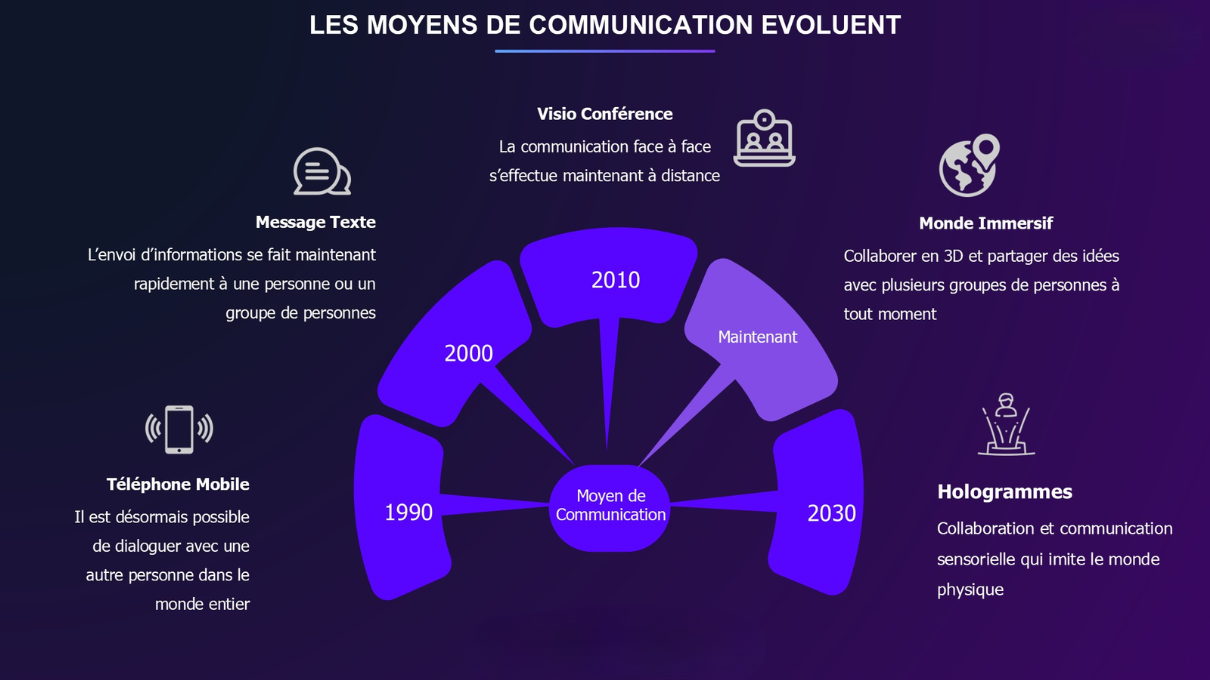
From Conversation to Immersion: An Evolution in 4 Steps
- The telephone : Voice breaks the distance, but imposes a simultaneous presence. It is an interaction rich in emotions but limited to two individuals, blind to each other.
- SMS and email : They introduce asynchronous communication. We communicate with several people at the same time, we gain in temporal efficiency, but we lose the warmth of the voice and the immediacy of the reaction.
- Video conferencing : It was our shield during recent crises. But it also revealed its limits: the famous "Zoom fatigue". The fixed 2D frame and the absence of real visual contact create an exhausting mental load, because our brain must compensate for the loss of 80% of non-verbal communication.
- The metaverse and immersive environments : This is the ultimate step. By reintegrating the notion of volume, movement and spatialization of sound, the metaverse does not just show the interlocutor: it simulates their real presence.
The Metaverse: The Next Frontier of Communication
The metaverse represents the most profound revolution that communication systems have ever known. It is no longer just about sending a message: the metaverse offers an immersive experience where users can meet and collaborate in a virtual 3D environment, as if they were physically in the same room.
Reenchanting remote collaboration: the KLONA approach
Unlike traditional meeting tools that close as soon as the discussion ends, an environment like KLONA offers a persistent space. In a business context, this changes everything: you no longer connect to a meeting, you "go to the virtual office".
This nuance is fundamental for employee engagement. In the professional metaverse, serendipity, the ability to meet people by chance, is restored. You run into a colleague near a whiteboard, you join a conversation informally. It's the direct remedy to the isolation of remote work and a concrete solution for employee experience (EX).
2030 : The Total Disappearance of the Digital Barrier
The next big step? The holographic avatar. By 2030, thanks to the convergence of the metaverse and Artificial Intelligence, it will be possible to project oneself as a hologram into the interlocutor's space. AI will play the role of facilitator, capable of translating instantly your words into any language while preserving your voice timbre.
In 2030, technology will no longer be an intermediary that we look at on a screen, but a fluid invisible allowing for near-perfect digital teleportation.
From smoke signals to holograms, each innovation has had only one goal: to bring people closer together. The evolution of communication methods reflects that of our society: ever faster, but above all ever more human in its quest for connection.
Switch to the communication of tomorrow today
Join the organizations that are not waiting for 2030 to revolutionize the way they collaborate. Transform your exchanges into real immersive experiences.
#deeptech #metaverse #telephone #visio #virtualreality #augmentedreality #innovation #transformationnumerique #evolution #communication