
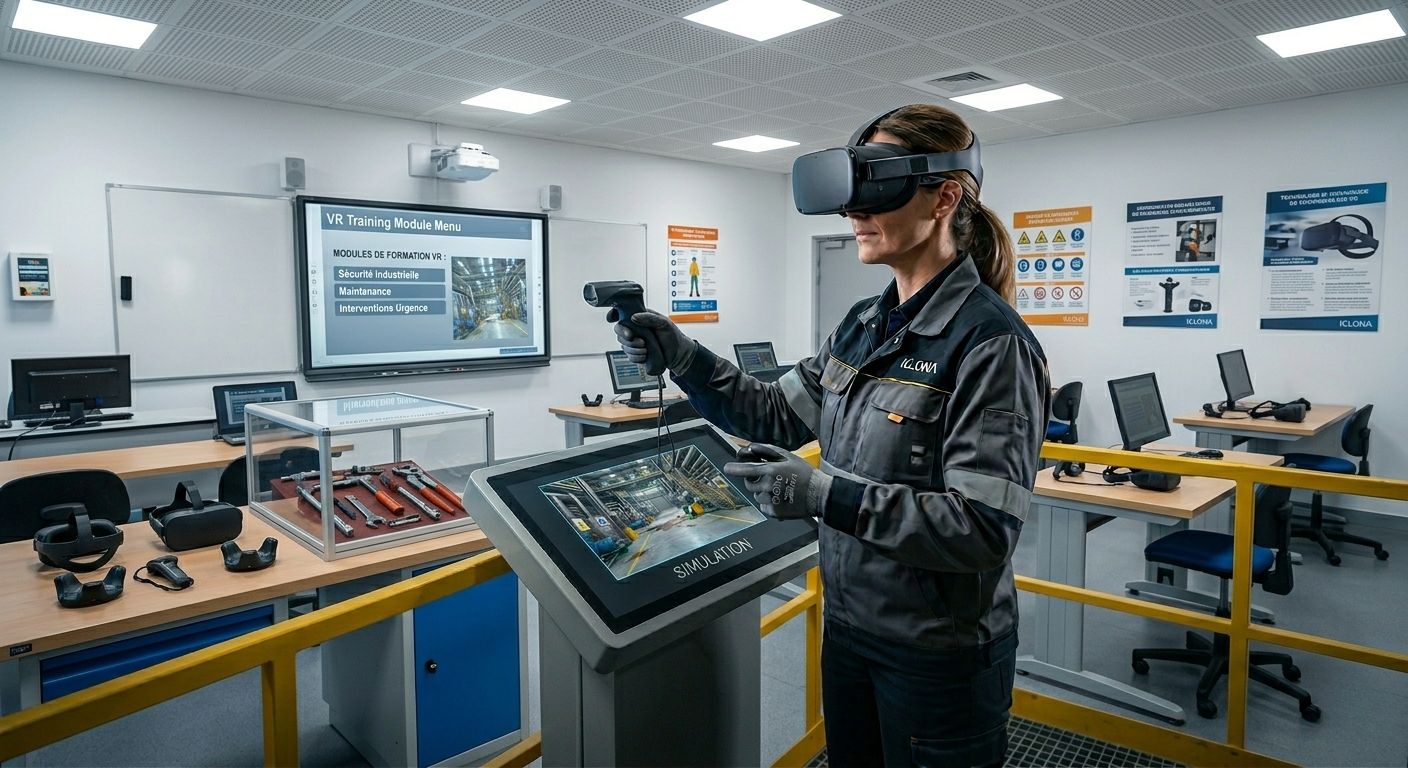
Corporate training facing its biggest challenge
Training employees has always been an investment. An investment in time, budget, and organization. But for a long time, the core issue was merely logistical: how to bring the right people to the right place, at the right time, with the right trainers?
Today, this question remains relevant but is overshadowed by another, much more fundamental one: is what we teach actually retained? Does training produce a lasting change in behavior, or simply a temporary validation of theoretical knowledge?
The answers provided by learning sciences to this question are clear-cut. And they all point in the same direction: we learn better by doing than by listening. We retain what we have experienced better than what we have read. We develop true reflexes by practicing in realistic situations, not by memorizing procedures on a slideshow.
This is precisely where virtual reality changes the game.
The limits of traditional training: what the studies say
Before examining what virtual reality brings, it's worth recalling what we know about the limits of traditional teaching methods.
As early as the end of the 19th century, the German psychologist Hermann Ebbinghaus described what he called the forgetting curve. His work shows that without review and practical application, a human being forgets on average 50% of what they just learned within the following hour, 70% within 24 hours, and up to 90% in a week. These figures, confirmed and refined by decades of research in cognitive science, raise a simple question: what is the point of a training course if almost all of its content is forgotten within a few days?
Traditional teaching methods like lectures, PowerPoint presentations, and passive videos put the learner in a receiver's position. They listen, watch, maybe take notes. But they do not do. They do not decide. They do not confront their knowledge with a real situation. And this is exactly what limits their effectiveness in the long term.
In-person training with an experienced trainer improves things through interaction and Q&As. Role-playing and scenario exercises go even further. But these formats have their own constraints: high cost, difficulty in scaling, impossibility of simulating certain dangerous or rare situations, and variability in quality depending on the trainers.
It is in this context that virtual reality stands out—not as a technological gimmick, but as a serious educational answer to well-documented problems.
What science says about virtual reality training
Evidence of virtual reality's effectiveness in corporate training no longer relies solely on testimonials or isolated case studies. It is accumulating in scientific literature, with consistent and significant results.
A recent study published in Scientific Reports, conducted on 200 industrial employees split between a group trained in virtual reality and a control group trained using traditional methods, measured the impact of each approach on three key dimensions: risk perception, understanding of safety procedures, and sense of self-efficacy.
The results are unambiguous. Participants trained through virtual immersion better identify dangerous situations, more finely understand the procedures to follow, and feel significantly more confident to react correctly to a real situation. The trend holds: VR-trained learners report being up to 92% more confident in applying their newly acquired skills on the field.
But beyond measured performance, it's perhaps the feelings that are the most revealing. Learners feel more involved, more attentive, better prepared. The immersive experience makes training more concrete, striking, and engaging.
These feelings directly translate into knowledge retention. Where traditional methods like lectures produce retention rates of 5 to 10%, virtual reality training achieves rates up to 75%. This is not an anecdotal gap: it's the difference between a training course that leaves a lasting mark and one where the essentials are forgotten even before returning to the workstation.
These results align with other studies conducted in recent years. In 2020, PwC carried out a large-scale comparative study on the respective effectiveness of classroom training, e-learning, and VR training. The conclusions confirmed that VR learners complete their training up to four times faster than those in traditional classrooms, with significantly higher levels of confidence and engagement. A meta-analysis published in the Journal of Medical Internet Research, covering dozens of studies in the field of medical training, concludes that virtual reality simulation statistically improves clinical performance compared to conventional teaching methods.
Why the brain learns better in virtual immersion
To understand why virtual reality produces such results, we must turn to what neuroscience tells us about how the human brain encodes memories and builds skills.
The brain does not fundamentally distinguish between a real experience and a sufficiently realistic immersive virtual one. When you experience a situation in virtual reality—even knowing it's a simulation—your brain activates the same emotional and motor circuits as if the situation were real. You feel a kind of stress when facing danger. You make decisions. You observe the consequences of your choices. And these experiences are encoded the same way as real memories.
This is what researchers call embodied cognition: we learn better when our body is physically engaged in learning, when we act within an environment rather than just observing information from the outside.
Virtual reality exploits this exact mechanism. By placing the learner at the heart of a realistic situation, by giving them the ability to act, fail, and try again, it creates the conditions for experience-based learning—the most robust and transferable kind available.
Added to this is an often-underestimated factor: the absence of judgment. In a virtual environment, learners can make mistakes without real-world consequences, without fearing the gaze of their colleagues or their trainer. This psychological safety promotes educational risk-taking, exploration, and curiosity—fundamental attitudes for deep learning.
VR training versus other methods: an honest comparison
It would be simplistic to present virtual reality as the sole solution to all corporate training challenges. Like any educational approach, it has its strengths, limits, and optimal conditions for use.
Lectures and passive e-learning are inexpensive to produce and easy to deploy on a large scale. They are suitable for transmitting factual information, regulatory knowledge, or awareness content. Their main limitation is learner passivity and the resulting low retention rate. They are effective as an entry point but insufficient alone to develop operational skills.
In-person training with an expert trainer offers interaction, real-time group adaptation, and the richness of human exchange. It remains irreplaceable for certain interpersonal or managerial skills. But its cost is high, its scalability is limited, and the experience quality heavily depends on the trainer. It is difficult to standardize across a large multi-site organization.
Physical simulations and scenarios allow practicing under conditions close to reality. They are particularly effective for technical trades. However, they are often impossible to set up for dangerous, rare, or complex situations that are hard to reproduce. They require equipment, dedicated spaces, and mobilize production teams.
Virtual reality training combines the advantages of physical simulation—practice in realistic conditions, learning from mistakes, developing reflexes—with the benefits of digital—scalability, standardization, accessibility, traceability. It can simulate situations that are impossible to reproduce safely, be deployed to thousands of geographically dispersed employees, and generate precise data on each learner's performance.
Its main limitation remains the initial content production cost, even though this has significantly decreased in recent years with the democratization of creation tools. Another limit is its unsuitability for developing purely interpersonal skills, where the authenticity of human interaction remains hard to replace.
The wisest conclusion is therefore not to choose between these approaches, but to intelligently combine them: use passive digital for theoretical knowledge, virtual reality for operational skills and risky situations, and classroom training for relationship dynamics and moments of collective reinforcement.
VR Training: sectors that have already taken the leap
Virtual reality training is no longer reserved for cutting-edge tech companies. It has been rolled out across highly diverse sectors, with concrete and measurable results.
- In manufacturing and workplace safety, this is arguably the area where benefits are easiest to see and best documented. Training an operator on emergency procedures, handling dangerous equipment, or evacuating an industrial site in real conditions is impossible without exposing people to actual risk. Virtual reality reproduces these scenarios realistically enough to build genuine reflexes, without ever endangering anyone. Industrial groups in the energy, chemical, aerospace, or construction sectors have deployed VR training systems and measured significant reductions in workplace accidents.
- In the healthcare sector, virtual reality simulation is transforming the training of medical and paramedical professionals. Surgeons practice complex procedures, healthcare teams rehearse managing emergency situations, medical students explore human anatomy in three dimensions. The stakes are both educational and ethical: allowing healthcare professionals to develop their expertise without relying on patients as guinea pigs.
- In retail and customer relations, brands are training their teams to handle difficult situations—aggressive customers, peak foot traffic, queue management—within realistic virtual environments. Employees develop behavioral and emotional reflexes in a safe setting before mobilizing them in the real world.
- In logistics and supply chain, training to drive machinery, organize warehouse flows, or manage receiving and shipping procedures directly benefits from virtual immersion. New employees can get to grips with their work environment even before their first day on site, drastically reducing the time needed to reach full operational efficiency.
- In management and leadership, innovative programs use virtual reality to put managers on the spot: handling a difficult interview, leading a crisis meeting, giving sensitive feedback. While the authenticity of human interaction remains superior in person, VR allows for safe, repeated practice that accelerates the development of behavioral skills.
Immersive training: why learning by doing changes everything
What fundamentally differentiates virtual reality training from all other digital approaches is that it turns the learner from a spectator into an actor.
By navigating a realistic and immersive environment, the participant doesn't just passively receive information. They test decisions, observe consequences, adjust behavior, and try again. They gradually internalize the right reflexes not because they memorized them, but because they experienced them. This difference is critical: skills built through experience are much more robust, far more transferable, and significantly longer-lasting than those formed by memorization.
Learning by making mistakes, without real-world consequences, is one of the most powerful educational mechanisms there is. Virtual reality is the only tool that leverages it on a large scale, for complex operational skills, in realistic environments.