
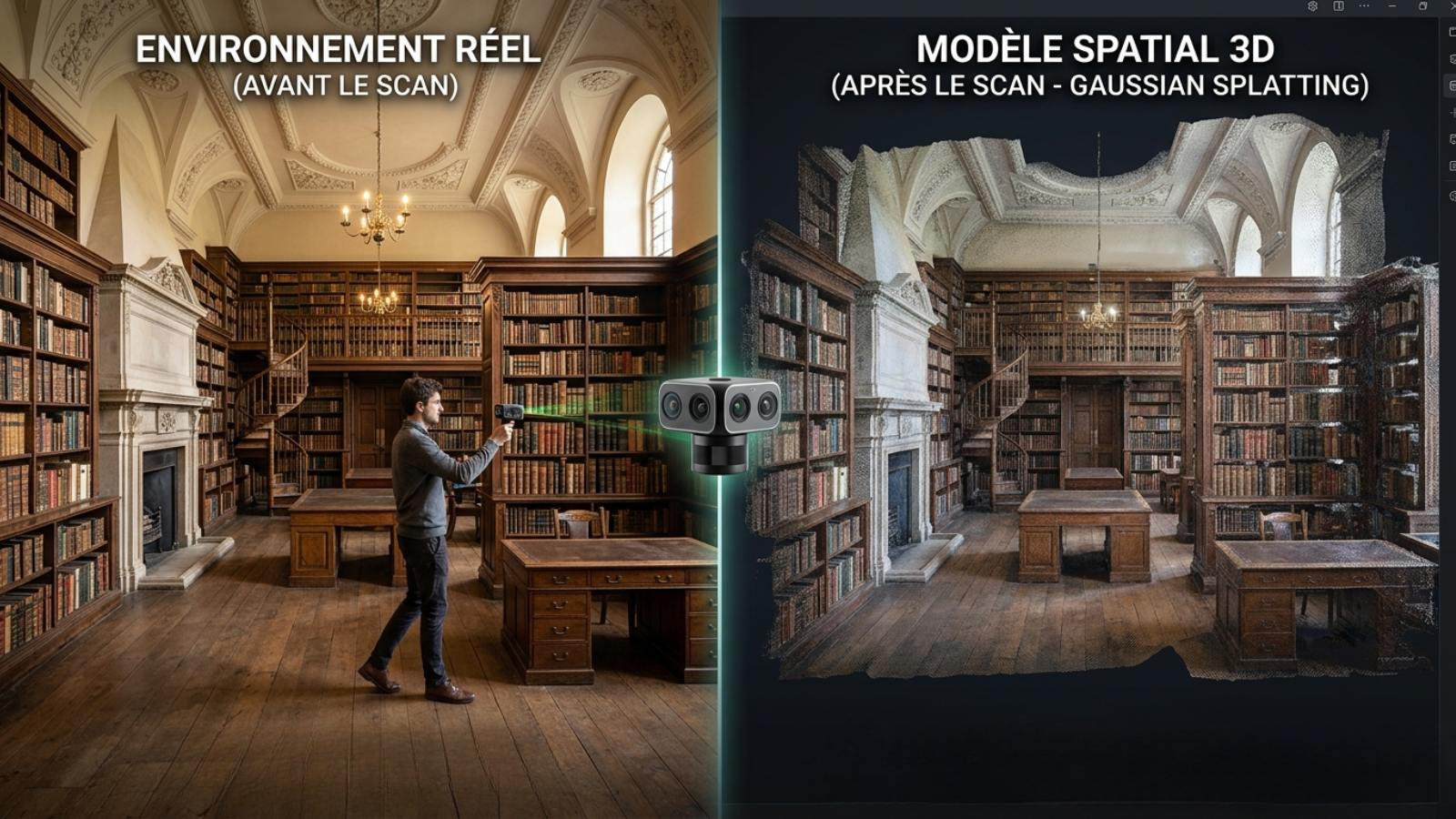
3D Capture: transforming reality into an immersive experience
Imagine being able to photograph your factory, showroom, or heritage site with a simple smartphone, and obtaining a photorealistic 3D environment a few hours later, fully navigable in real-time from any web browser.
Without a 3D modeler. Without complex software. Without a studio budget.
This is no longer science fiction. It is what 3D Gaussian Splatting enables today. It is a technology that established itself in just a few months as one of the most significant breakthroughs in the field of 3D reconstruction and rendering.
What is 3D Gaussian Splatting?
3D Gaussian Splatting, often abbreviated to 3DGS, is a 3D reconstruction and rendering method based on a radically different representation compared to traditional approaches.
Instead of modeling a scene using polygons, meshes, or voxels, 3DGS represents space as millions of tiny entities called Gaussians.
Concretely, these are three-dimensional ellipsoids, each defined by a position in space, a shape, a color, an opacity, and a way of reacting to light depending on the viewing angle. Each of these Gaussians is tiny, often invisible on its own. But millions of them, assembled and rendered together, recreate a scene with breathtaking visual fidelity, including textures, reflections, depth, and materials.
3D Gaussian Splatting was introduced in August 2023 in a research paper co-authored by researchers from INRIA and several European universities. The paper immediately had a massive impact in the computer vision and computer graphics communities. Within a few weeks, open-source implementations emerged, startups were founded around this technology, and major tech players began integrating it into their production pipelines.
The process occurs in 2 steps:
- First is capture: the real scene is photographed or filmed from multiple angles. A recent smartphone is sufficient in many cases, although a higher-quality camera and rigorous angular coverage improve the final result.
- Second is reconstruction: an algorithm analyzes all the images and determines the position and properties of each Gaussian so that their combined rendering optimally matches the source photos. This process leverages the GPU to speed up calculations and can be completed in a few hours depending on the scene's complexity.
Once the Gaussians are generated, real-time rendering becomes possible. Each Gaussian is projected onto the screen according to the observer's viewpoint, and their combined contributions form the final image. All this occurs at display rates suitable for interactive navigation, between 30 and 60 frames per second.
The advantages of 3DGS for businesses
- The first point is implementation speed. Where a traditional 3D modeling project might involve a team for several weeks, 3DGS slashes production time to a few hours or days depending on the scene's complexity. Field capture is quick, and the reconstruction pipeline is increasingly automated.
- The second is photorealistic fidelity without manual modeling. The obtained rendering stems directly from reality. There is no artistic interpretation from a modeler, no approximated textures, no simplified geometry. The captured scene is the rendered scene, complete with its materials, its reflections, its imperceptible details. For use cases where adherence to reality is critical—technical training, site tours, heritage documentation—this is a decisive advantage.
- The third is universal accessibility of the rendering. 3DGS scenes can be viewed interactively, in real-time, from a standard web browser. No plugin, no application to install, no high-end graphics card required on the user's end. This accessibility is a key factor for companies wanting to deploy their experiences at scale.
- The fourth is scalability. Once the capture and reconstruction pipeline is mastered, this approach can be rolled out across tens or even hundreds of sites or products with decreasing marginal costs—a tremendous asset for multi-site companies or extensive product catalogs.
Immersive solutions: concrete use cases for your business
In the industrial and maintenance sector, 3DGS is transforming remote technical training. Training a technician to work on a complex machine traditionally involves either physical on-site presence or the use of poorly immersive 2D illustrated manuals.
With 3DGS, a team photographs the equipment in a few hours. In less than a day, a photorealistic digital twin is available, navigable from a browser or a VR headset. Technicians can explore the environment, identify components, practice procedures (remotely, at their own pace, without tying up the production line).
A European industrial energy group used this approach to train its maintenance teams on geographically scattered facilities, significantly reducing travel while standardizing training.
In real estate and architecture, 3DGS goes far beyond the limits of conventional virtual tours. 360° panoramas offer limited immersion: one cannot navigate freely, depth is simulated, and the experience feels flat.
With 3D Gaussian Splatting technology, the space is rendered in true three dimensions, freely navigable from any angle. A buyer can literally move through a property, look under the staircase, closely examine finishes, and project themselves into the space with a fidelity impossible to match with photographs.
A Parisian architectural firm has integrated this approach into its client presentation process: even before work begins, physical models are captured and shared as navigable 3D experiences. Clients better grasp the project, validation cycles are reduced, and the firm clearly stands out from its competitors.
In retail and e-commerce, 3DGS directly tackles the issue of product returns. Return rates remain a major challenge in online retail, often linked to a gap between how a product looks on the screen and its physical reality.
With 3DGS, physical items (furniture, equipment, decorative objects) are captured and rendered in photorealistic 3D. The customer can spin the product around, observe every detail, and appreciate the actual materials and proportions.
A high-end French furniture brand deployed these visualizations for its flagship items and saw a noticeable increase in conversion rates, coupled with a measurable reduction in returns.
In training and onboarding, 3DGS accelerates the integration of employees into complex environments. Distribution centers, hospitals, production sites: getting familiar with these spaces takes time and ties up experienced trainers.
With 3DGS, real workspaces are captured and integrated into immersive training paths. A new employee can explore their future workplace even before their first day, familiarize themselves with procedures, and identify critical areas—all from home or a training room.
A major retailer used this approach for its logistics teams in new warehouses, with a direct impact on productivity during the first weeks on the job.
In the heritage and culture sector, 3DGS democratizes high-quality digitization.
Previously reserved for well-funded institutions, heritage digitization is becoming accessible to museums, local governments, or cultural associations at far lower costs, with rendering quality rivaling professional approaches.
The results are accessible online, easily shareable, and integrable into educational experiences. Several French municipalities now use 3DGS to digitize local historical monuments, create virtual tours accessible to people with reduced mobility, and build precision digital archives.
3D Gaussian Splatting: towards a new era of interactive immersive experiences
In conclusion, 3D Gaussian Splatting represents not just a technological evolution, but a true disruption in how we capture, render, and leverage reality in 3D. By making the creation of photorealistic environments accessible in hours, without advanced technical expertise or high production costs, this approach paves the way for a new generation of immersive experiences.
But the real revolution begins when these scenes become interactive, scripted, and usable for business.
Thanks to KLONA XR Studio, businesses and studios can now easily integrate Gaussian Splatting-captured scenes to design custom environments perfectly suited to their use cases. It becomes possible to enrich these spaces with dynamic 3D elements, overlapping images and videos, interactive quizzes, and structure genuinely scripted journeys.
We no longer just 'visit' a place: we live an experience. Real-condition training, immersive onboarding, innovative tours, interactive product demos... the possibilities are endless.
Moreover, this power is now accessible via a no-code approach, enabling business teams to create, test, and deploy their experiences without relying on complex technical resources. Content can be instantly distributed on a massive scale via the web, accessible from a simple browser, with no installation or hardware constraints on the user's end.
3D Gaussian Splatting, combined with KLONA XR Studio, thus transforms reality into a playground for learning, exploration, and engagement. A major leap forward that redefines the standards of immersion and places businesses at the dawn of a new era of digital experiences.