
What if the real breakthrough was not where we expected it?
For several years, the debate about the future of education and work has revolved around a poorly framed question: will virtual replace physical? On one hand, advocates of all-digital learning announce the end of campuses, offices, and training rooms. On the other hand, supporters of in-person learning claim that nothing will ever replace the richness of face-to-face interaction.
This debate is a false dilemma. And a German university has just demonstrated this in the most concrete way possible.
The UDS, the German University of Applied Sciences, founded with the ambition of becoming the world's first entirely virtual university, has just inaugurated a physical campus in Potsdam, Germany. Not in contradiction with its original mission. But precisely because it understood it so well that it saw the limits and decided to overcome them.
This decision is more than an institutional anecdote. It illustrates a profound paradigm shift in how we conceive learning, working, and collaborative spaces. A shift that we at KLONA observe, support, and embody every day.
UDS: the birth of a university without walls
The German University of Applied Sciences was founded with a radical conviction: higher education could and should free itself from geographical constraints, rigid schedules, and national borders. In a world where talents are scattered all over the globe and where professional or family constraints often prevent access to quality training, building an entirely virtual university was not a technological bet. It was a social bet.
UDS thus built its model in virtual worlds. Immersive classrooms where students meet as avatars. Virtual libraries accessible at any time, from any country. International conferences to which one simply has to connect to participate. Modular courses that everyone follows at their own pace, according to their availability, without ever having to commute.
The model demonstrated its relevance. Students from dozens of different countries were able to access quality training that they never could have joined in a traditional setting. The flexibility, accessibility, and scalability of the virtual ecosystem have proven themselves.
And yet, UDS decided to build a physical campus.
Why open a physical campus when you've bet everything on virtual?
The answer lies in one sentence spoken by Mike Friedrichsen, co-founder of UDS:
"We are human beings and we will always need places to meet and collaborate."
This sentence, as simple as it seems, is actually the result of a subtle and honest observation about human nature and what virtual can and cannot provide.
Virtual excels at breaking down constraints. It erases distances, makes schedules flexible, and broadens access. It allows an engineer based in Lagos to take a course taught by a professor from Berlin, an entrepreneur from Seoul to collaborate in real-time with a team in Montreal, a student with 3 kids to train without leaving their home.
These contributions are real, measurable, and transformative.
But virtual cannot, on its own, recreate certain fundamental dimensions of human experience. The serendipity of an informal conversation in a hallway, which sparks an idea or an unexpected collaboration. The density of a group discussion where unsaid things, hesitations, and enthusiasms can be read on faces. The feeling of belonging to a community that shares not just ideas, but a space, an atmosphere, a culture.
This is not a weakness of virtual. It is simply the recognition that certain dimensions of the human experience are intrinsically tied to physical co-presence. And that true intelligence, for an institution taking its educational mission seriously, is not to choose between the two but to know how to orchestrate both.
A physical campus designed as a catalyst
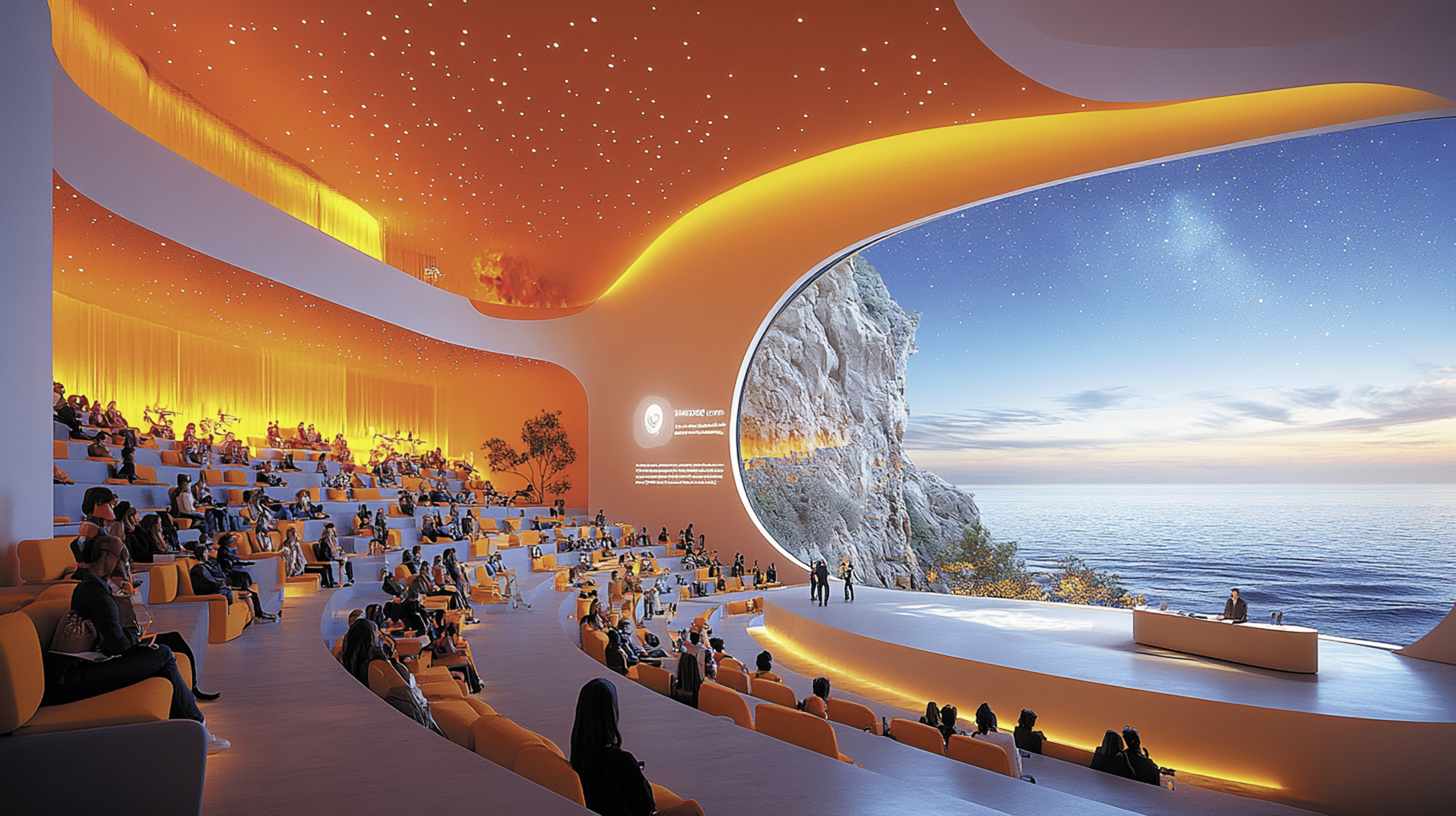
The Potsdam campus is not a traditional campus. It was not built to reproduce what existed before virtual universities. It was designed to do what virtual cannot do and nothing else.
Designed in partnership with Steelcase, one of the world leaders in workspace and learning environments, the UDS campus is architecturally and functionally focused on a single goal: catalyzing exchanges, meetings, and collaborations.
There are open amphitheaters designed for participatory formats, modular collaborative rooms thought to spark group ideas, quiet concentration zones for deep individual work, and casual cafes and lounges because the most fruitful ideas often arise in these in-between spaces.
What most distinguishes this campus from traditional institutions is its permeability. The space is not reserved solely for enrolled UDS students. It is open to businesses, start-ups, professionals, to anyone who wants to join a community focused on learning and innovation. The goal is to remove the barriers between the academic and professional sectors, to make learning rooted in daily life and in the realities of the working world.
Virtual and physical: two complementary spaces
What UDS concretely illustrates is a truth that the most advanced organizations are beginning to integrate: virtual and physical are not competing. They are complementary. And their intelligent combination produces something that neither can achieve alone.
Virtual brings flexibility, accessibility, and scalability. It allows reaching geographically dispersed audiences, training employees at their own pace, and maintaining team cohesion across time zones.
Physical brings relational density, serendipity, and a sense of belonging. It creates the conditions under which lasting bonds of trust are forged, collective projects take shape, and individuals feel like members of a community rather than mere users of a service.
The question is therefore no longer "virtual or physical?", but "how to articulate both so that each does what it does better than the other?" This articulation fundamentally transforms the learning and collaboration experience. Physical meetings become more intentional, wealthier, because they are prepared and extended by virtual interactions. Hybridization is not a compromise between two formats. It is a new way of conceiving learning and workspaces.
What this changes for organizations
The UDS example has concrete and immediate implications for all organizations, businesses, training organizations, and large multi-site structures.
In terms of training, combining immersive virtual modules and in-person sessions focused on exchange and practice multiplies the impact of educational programs. Learners progress at their own pace in virtual environments, then meet in person to deepen, practice, and connect.
In terms of collaboration, geographically dispersed teams benefit from shared virtual spaces for their day-to-day exchanges. Moments of physical presence (seminars, workshops, events) become times for consolidating human bonds and accelerating collective projects, with a tenfold increase in efficiency.
In terms of communication, immersive virtual experiences make it possible to reach large and dispersed audiences with rich and engaging content (site tours, product demonstrations, virtual events) while preserving the ability to create memorable physical experiences for the moments that warrant it.
The KLONA vision: immersion as a bridge, not a substitute
This vision of complementarity between virtual and physical resonates deeply with how we view our mission at KLONA.
We have built a no-code platform that allows any organization to create, manage, and scale its own immersive 3D and VR experiences. Without complex setup. Without technological barriers. From a computer, a tablet, a smartphone, or a VR headset.
But our conviction goes beyond technology. We do not believe that virtual immersion is there to replace real human interactions. We believe it is there to amplify them. To make collaboration possible between dispersed teams. To prepare richer and more intentional physical meetings. To extend and enrich physical moments by giving them a virtual continuation that maintains the bond over time.
Our collaborative virtual worlds are not substitutes for real spaces. They are bridges.
Hybridization is not a trend, it is a profound transformation
UDS did not open a physical campus because its virtual model failed. It opened one because it understood that educational excellence required going further—and that "further" meant smartly combining the best of both worlds.
The future of workspaces and learning is hybridization. Not as a compromise between two opposing constraints, but as an architecture deliberately designed to draw the best from each modality. The most agile organizations have understood this. The most innovative are already turning it into a competitive advantage.
The question is no longer whether this transformation will happen. It is already underway. The question is how fast your organization will position itself to take advantage of it.
Want to explore how immersive experiences could enrich your training, collaboration, or communication programs? Contact the KLONA team for a personalized discussion or request a demo of our platform.