
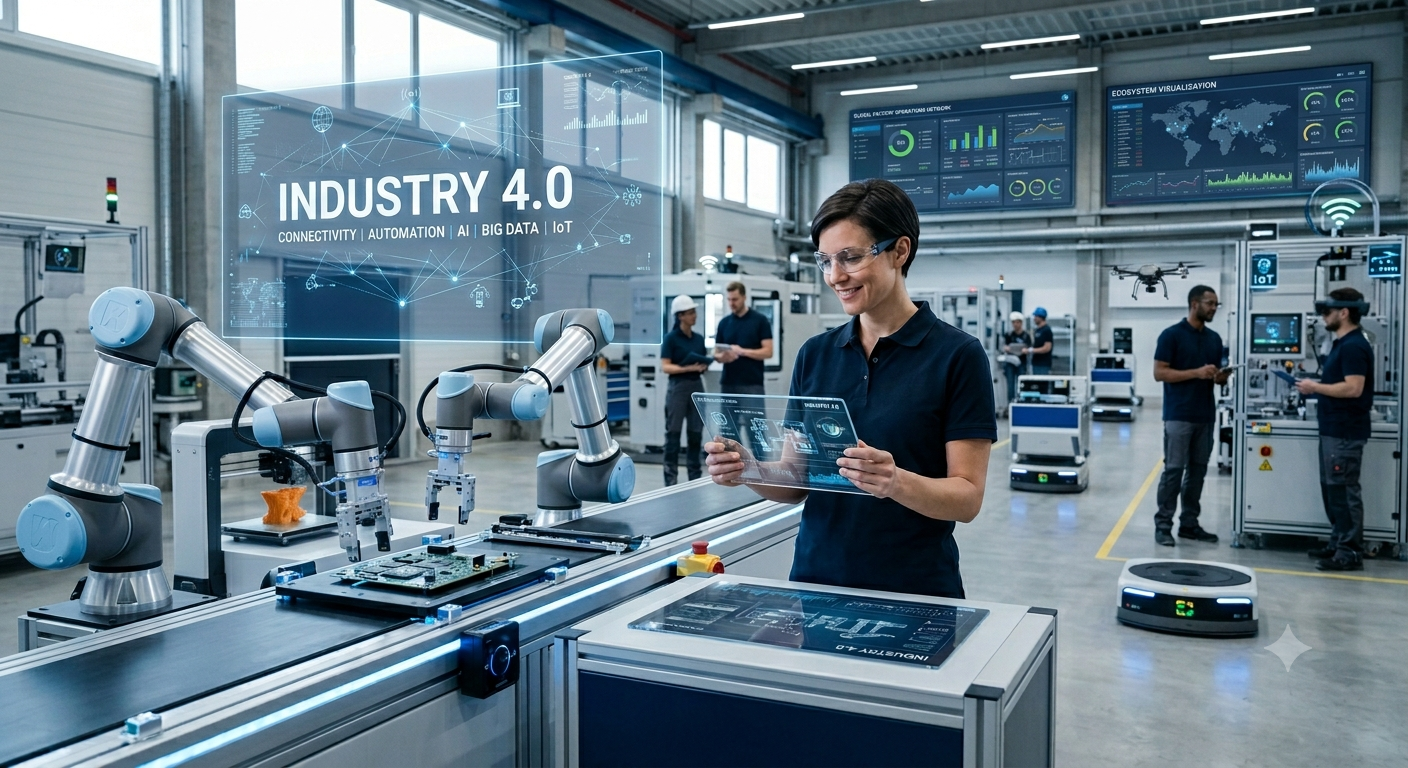
Industry 4.0 is the convergence between the physical world and the digital world at the heart of production environments. Not just another technology trend, but a paradigm shift that profoundly reconfigures the way we design, produce, and maintain.
This movement is now quantified, documented, and underway on a large scale. According to Mordor Intelligence, the global Industry 4.0 market is expected to grow from $94.42 billion in 2023 to $241.58 billion by 2028, representing a compound annual growth rate of nearly 20.67% over the period. An unambiguous signal: the digital transformation of industrial environments is no longer a distant horizon. It is happening now, on a large scale.
The technological building blocks of Industry 4.0
To understand what Industry 4.0 actually encompasses, we must look at the technologies that make it up. Taken in isolation, each represents a significant step forward. Combined, they redefine what makes a factory performant.
Industrial IoT, or the Industrial Internet of Things, relies on connected sensors that transmit real-time data from machines and production lines. These information flows make it possible to detect anomalies before they turn into breakdowns, optimize cycles, and control equipment remotely. AI-driven predictive maintenance, which relies precisely on this real-time data, can improve labor productivity by 5% to 20% and reduce downtime by up to 15%.
Cobotics introduces a different logic. Collaborative robots (cobots) work alongside operators, rather than replacing them. They handle repetitive or physically risky tasks, while technicians focus their attention on supervision, quality control, and value-added decisions. The widespread adoption of cobots addresses chronic labor shortages and the need for flexibility in batch sizes, two major constraints for manufacturers in 2025.
Digital twins are perhaps the most structural building block. These virtual replicas of equipment or entire environments make it possible to simulate production scenarios, anticipate failures, and optimize processes without halting any physical facilities. According to a report by the World Economic Forum, smart factories enabled by Industry 4.0 technologies have demonstrated up to a 30% increase in productivity and a 50% reduction in downtime.
Intelligent automation and real-time data complete this set. It is no longer just about automating fixed tasks, but about deploying systems capable of adapting their behavior based on received data, and making operational decisions based on fresh information rather than weekly reports.
France facing the industrial acceleration
In France, industrial modernization is organizing and accelerating. From the "Industrie du Futur" project to the creation of the French Fab network, modernizing French industry is a national challenge, conditioned by adapting employees to new technological offerings, digital tools, and human-machine collaboration.
Mid-sized companies and large industrial groups are no longer asking if they will transition to Industry 4.0. They are asking how fast, and how to bring their teams along in this transition. Many companies of all sizes have already taken the leap: modernizing production equipment, automating, adopting digital technologies, robotics, big data, and augmented reality. Most have had to redefine their processes and deploy an active training policy.
Public support programs testify to the scale of this challenge. OPCO 2i and the Ministry of Labor joined forces to help industrial companies anticipate their employees' skills in the face of digital and ecological transitions, with €75 million mobilized in 2023 for this specific fund.
Skills development: the real challenge of the 4.0 transformation
This is where the real question arises. You can deploy the best equipment in the world. If operators are not trained to use it, maintain it, and react to unexpected events, the transformation remains incomplete. A workforce skilled in robotics, artificial intelligence, data analysis, and cybersecurity is now indispensable for French industry. Continuous training, skills upgrading, and retraining of personnel have become strategic levers for attracting and retaining talents.
"Industry 4.0 is not just about technology. It is about upgrading the skills of the women and men who run the production lines."
Immersive training: a concrete response to industrial challenges
This is where KLONA comes in.
Training operators on complex equipment, risky technical procedures, or maintenance procedures on machines that cannot be stopped is a real, daily, and often underestimated challenge. Traditional methods face concrete constraints: equipment availability, learner safety, and the cost of errors in real conditions.
KLONA's immersive solutions make it possible to faithfully recreate these industrial environments in virtual reality or through interactive digital twins. Operators train on virtual replicas of their own equipment, under realistic conditions, with no risk and without disrupting production.
From identifying training use cases to field deployment, KLONA supports manufacturers at every step, ensuring that the 4.0 transformation leaves no one behind.
Is your company in the middle of an industrial transition?
Let's talk about it. Discover how virtual reality and digital twins can accelerate your transformation.
Speak with a KLONA expert