
What is a Serious Game? The immersive training that transforms learning
Training your employees is good. Having them live the experience is better!
This sentence might sound like it came straight out of a consultant's speech. Yet, it sums up something very concrete: most corporate training still relies on a model where the learner receives information passively, linearly, often behind a screen. And most of the time, this information evaporates within a few days. Not due to lack of goodwill, but by its very nature.
The Serious Game offers another path. Not as a pedagogical gimmick, but as a structured response to a problem that many training managers know well: how to ensure that what is taught is truly retained, truly applied?
Why Serious Games make learners active participants in their training
Traditional pedagogy is based on a transmission model: a trainer holds knowledge, transmits it, and the learner receives it. This model has spanned decades of teaching, in business as well as in school. It has its virtues, particularly for transmitting factual knowledge or conceptual frameworks. But it reaches its limits when it comes to developing behavioral skills, decision-making reflexes, or operational know-how.
The Serious Game aligns with a completely different logic, inherited from the theories of experiential learning developed notably by the American psychologist David Kolb in the 1980s. According to this model, the most effective learning comes through lived experience, reflection on that experience, conceptualization, and then active experimentation.
"We really learn by doing, not just by listening."
In a Serious Game, the learner is put into a situation right from the start. They test hypotheses, make decisions in a simulated context, make mistakes, and observe the consequences. They are not a spectator of the training; they are the protagonist. This change in posture profoundly transforms how knowledge and skills become anchored over time.
How Serious Games improve training engagement
Let's ask the question frankly: how many training sessions have you attended from which you retained almost nothing two weeks later?
This is not a rhetorical question. It's the starting point of many of our conversations with training managers. Engagement is the central challenge, not superficial engagement—the kind that consists of being physically present in a room or having clicked on "start module." Real engagement, the kind that makes a learner pay attention, reflect, retain, and reinvest what they've learned in their daily work.
A slideshow, however well-designed, constantly fights against distraction. In a professional context where demands are constant, maintaining attention on passive content is often a losing battle. The human brain simply isn't wired to stay focused on uniform, non-interactive stimuli.
The Serious Game creates the conditions for authentic engagement by leveraging mechanics refined by the world of gaming over decades: a scenario to solve that sparks curiosity and narrative tension, a clear and achievable objective that gives meaning to each action, and visible progress that builds a sense of mastery.
Knowledge retention: Serious Games are 3 times more effective than traditional training
There is a fundamental difference between reading a safety rule on a sheet and having to apply it in an incident simulation.
In the first case, the information is temporarily stored in working memory, without necessarily being consolidated into long-term memory. In the second, it anchors itself durably because it is associated with an emotion, a decision, a lived consequence even if simulated. This phenomenon is well documented by neuroscience: the amygdala, a brain structure involved in processing emotions, plays a central role in memory consolidation. Information associated with an emotional experience is significantly more likely to be memorized durably than information received passively.
Concretely, data from KLONA deployments show that learners retain 3 times more information on average with immersive training than with a traditional approach. On critical subjects such as workplace safety, professional gestures, or emergency procedures, this difference is not trivial. It can make a real difference in operational reality.
Serious Game: how failure becomes a teaching tool
In a real work environment, failure almost always has a cost. Operational, human, sometimes financial. And even when this cost remains limited, the fear of judgment often inhibits initiative. The result: employees don't dare to test, don't explore uncertain areas, and stick to the beaten path even when another approach would be more effective.
The Serious Game offers something rare in the professional context: a protected space where failure has no real consequence. You can make the wrong decision in a difficult interview simulation, mishandle a crisis situation, forget a critical step in a procedure, and learn from it without anyone being put in danger.
"This freedom to fail changes everything!"
It transforms failure from an obstacle into information. You try, you fail, you understand why, you try again differently, you progress. This natural cycle in the game is the most effective cycle for building solid and lasting skills.
Serious Game and real cases: training directly applicable in the company
This is often the question that comes up at the end of a demonstration: "That's all well and good, but will my teams really be able to apply this the next day?"
The answer is yes, provided that the Serious Game is designed based on your real situations. Unlike generic off-the-shelf training, a well-designed Serious Game relies on the concrete cases that teams encounter daily: a safety inspection on an industrial site, a difficult managerial interview, the integration of a new quality process, handling a dissatisfied customer.
This anchoring in operational reality has a direct consequence on the transfer of learning. What is learned in a simulated context close to the real context is more easily mobilized in the real situation. The training doesn't stay in the room, it follows the employee to their workstation.
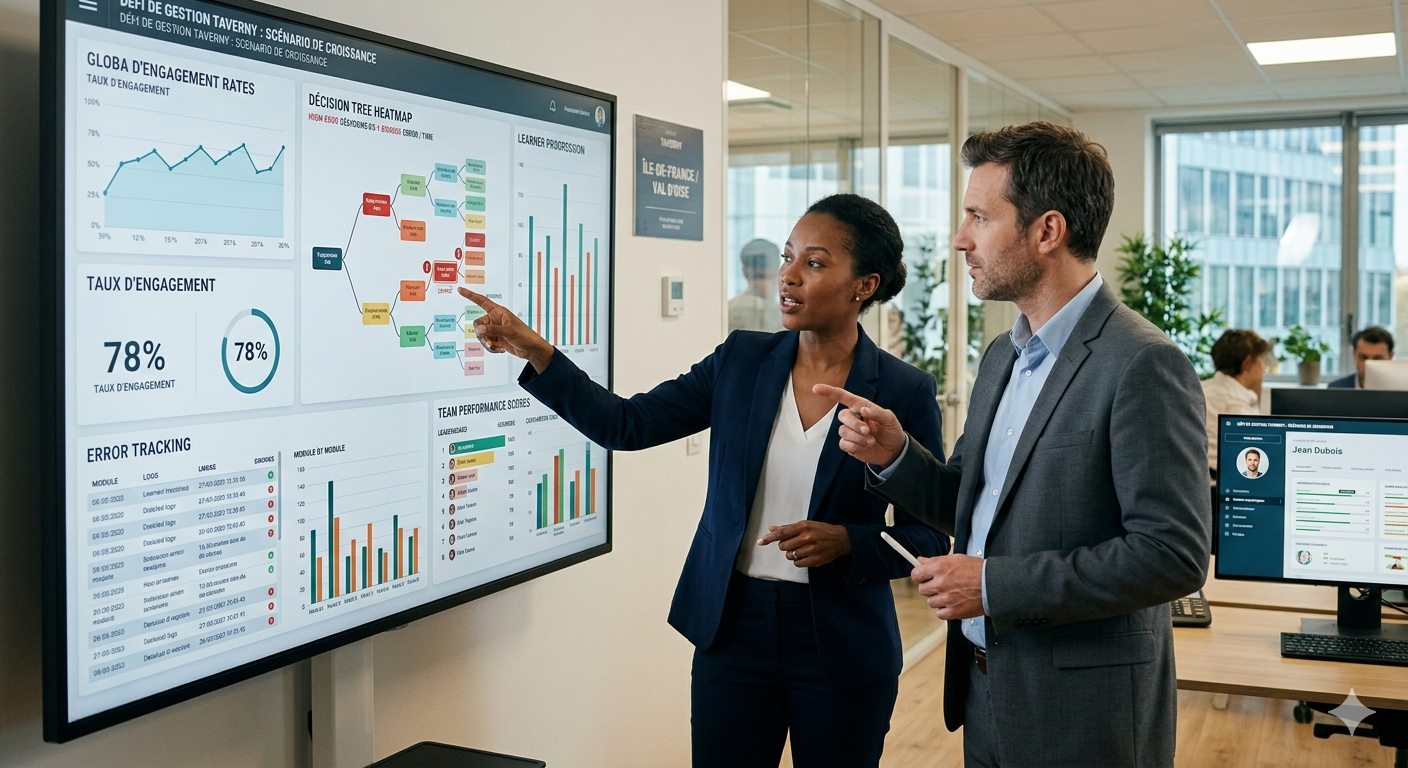
And because each interaction is recorded and analyzed, training managers have precise data on the real effectiveness of the courses: which decisions were made, where errors are concentrated, how progress evolves. This data makes it possible to identify collective shortcomings and to demonstrate concretely the value of the training investment, which often remains one of the major challenges for HR and Learning & Development teams.
Serious Game in the company: how to concretely measure the progress of your teams
Reinforced engagement, three times higher memorization, immediate applicability of learning, real-time measurement of results. The Serious Game is not just another teaching trend; it is a measurable response to the concrete challenges of professional training.
And the arguments are not only pedagogical. Data observed by KLONA shows that immersive training costs on average 40% less than equivalent in-person training and can be deployed up to 100 times faster at scale. For organizations that need to train hundreds or thousands of employees, this is an argument that speaks directly to general management and CFOs, not just to training teams. However, the Serious Game must be designed to meet your specific needs and not as a generic solution applied to particular requirements.
What if the Serious Game became a real collaborative experience?
This is the vision that drives KLONA. We support companies in the design and deployment of custom Serious Games dedicated to employee training, on various topics: safety, development of managerial skills, onboarding or upskilling for technical roles.
Our immersive experiences allow participants to form teams and tackle concrete challenges together. Embodying an avatar, exploring a 3D environment inspired by video game aesthetics, solving puzzles, answering quizzes, and facing field situations: everything is designed to encourage learning through action and collaboration.
To reinforce this collective dynamic, players have access to real-time communication tools such as chat, audio, and camera sharing, to cooperate effectively throughout the experience.
If you want to discover concretely what this approach can bring to your teams, come and explore KLONA's Serious Games.