
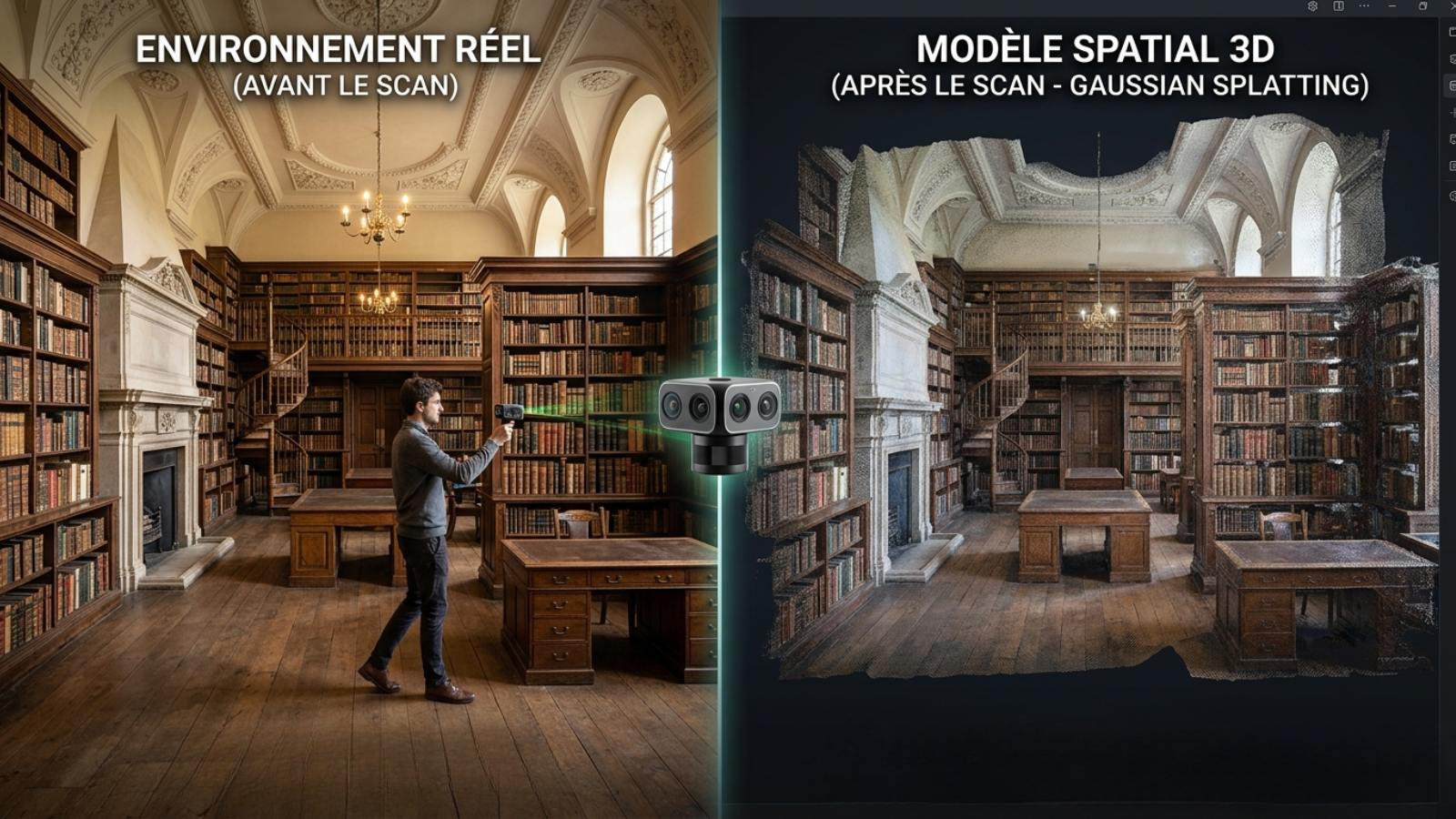
3D Gaussian Splatting is generating a lot of buzz in tech conferences, professional networks, and product roadmaps of immersive industry players. But between a laboratory demonstration and operational field use, there is often a gap that no one really documents.
At KLONA, we decided to test the technology in real-world conditions: indoors, outdoors, across various environments. Not to validate a marketing hypothesis, but to concretely understand what 3DGS implies in terms of protocol, constraints, and opportunities, especially for our immersive training use cases.
What we learned is not quite what we expected.
3D Gaussian Splatting: Principles and How It Works
For those new to the technology: 3D Gaussian Splatting is a 3D reconstruction method that transforms a series of photos or videos into a photo-realistic volumetric environment, explorable in real-time.
Concretely, you capture a space with a camera or smartphone, and you get an immersive 3D scene — without modeling, without CAD software, and without graphic designer intervention. The algorithm reconstructs the geometry and textures of the environment from the captured images, representing the scene as millions of 3D "Gaussians" that restore light, depth, and relief.
The result: a digital replica of a real space, navigable in real-time and with a visual fidelity that is hard to achieve by other means.
3D Gaussian Splatting in Real-World Conditions: 3 Key Takeaways
1. Equipment is not the deciding factor. Gestures are.
First surprise, and probably the most structural: we anticipated that rendering quality would mainly depend on the equipment used — sensor resolution, optical stabilization, lens quality. In practice, the capture gesture makes all the difference.
Moving too fast produces blurry images that degrade the reconstruction. What matters is controlled slowness: a smooth, steady movement that gives the algorithm enough consistent information to faithfully reconstruct each volume.
This directly changes how we prepare and brief a capture session. It's not a technical skill in the classic sense — it's a physical discipline, almost artisanal.
2. Camera height determines what exists in the scene.
Second takeaway, more specific to outdoor captures: the vertical position of the camera during capture defines what will or won't be rendered in the final output.
A camera positioned at chest height correctly captures the ground environment and human-height elements. But overhanging volumes — the roof of a vehicle, the top of an industrial cabinet, the peak of a structure — disappear from the render or end up underrepresented.
This is a detail that might seem minor. In reality, it deeply changes how we plan a capture path, depending on the elements we want to faithfully reconstruct. For maintenance training or HSE inspection use cases, this type of gap is unacceptable.
The operational conclusion: the capture path must be planned in advance, angle by angle, based on the critical elements to be reconstructed — rather than improvised on the field.
3. The unexpected range of 3DGS
While the first two takeaways were more about constraints to master, the third is an excellent surprise.
3D Gaussian Splatting renders environments far beyond what we anticipated, with a level of detail that holds up all the way to the background. Wide spaces, deep perspectives, distant elements — the technology integrates them with a visual coherence that exceeds our initial expectations.
For extensive industrial environments, logistics sites, or complex outdoor spaces, this is a capability that opens up use cases we previously considered out of reach for lightweight capture.
Integrating 3D Gaussian Splatting into an Immersive Training Project
These takeaways don't just stay in an internal test report. They feed directly into our project preparation protocol.
Concretely, this translates to:
- A capture path defined in advance, adapted to the site's geometry and priority elements to reconstruct.
- Anticipating critical angles — heights, overhangs, areas with high visual density — even before arriving on the field.
- A differentiated protocol according to the type of environment: indoor capture and outdoor capture do not follow the same constraints, and thus are not prepared the same way.
The goal is to arrive on site with a proven methodology to deliver a usable render from the very first session — without back-and-forth corrections that lengthen deadlines and needlessly mobilize client teams.
For immersive training projects, this means scenes ready to be integrated directly into a training module, without technical friction for the end client.
3DGS Field Report: What the Technology Really Demands
3D Gaussian Splatting delivers on its promises — provided we don't underestimate what field implementation really requires. The technology is powerful, but rendering quality is decided before the capture, in the preparation, path, and gestures.
"What this test confirmed to us: the value lies not only in the tool, but in the method surrounding it."
Have you already experimented with 3DGS in the field?
What surprises did you encounter? Feel free to share your feedback with our teams.